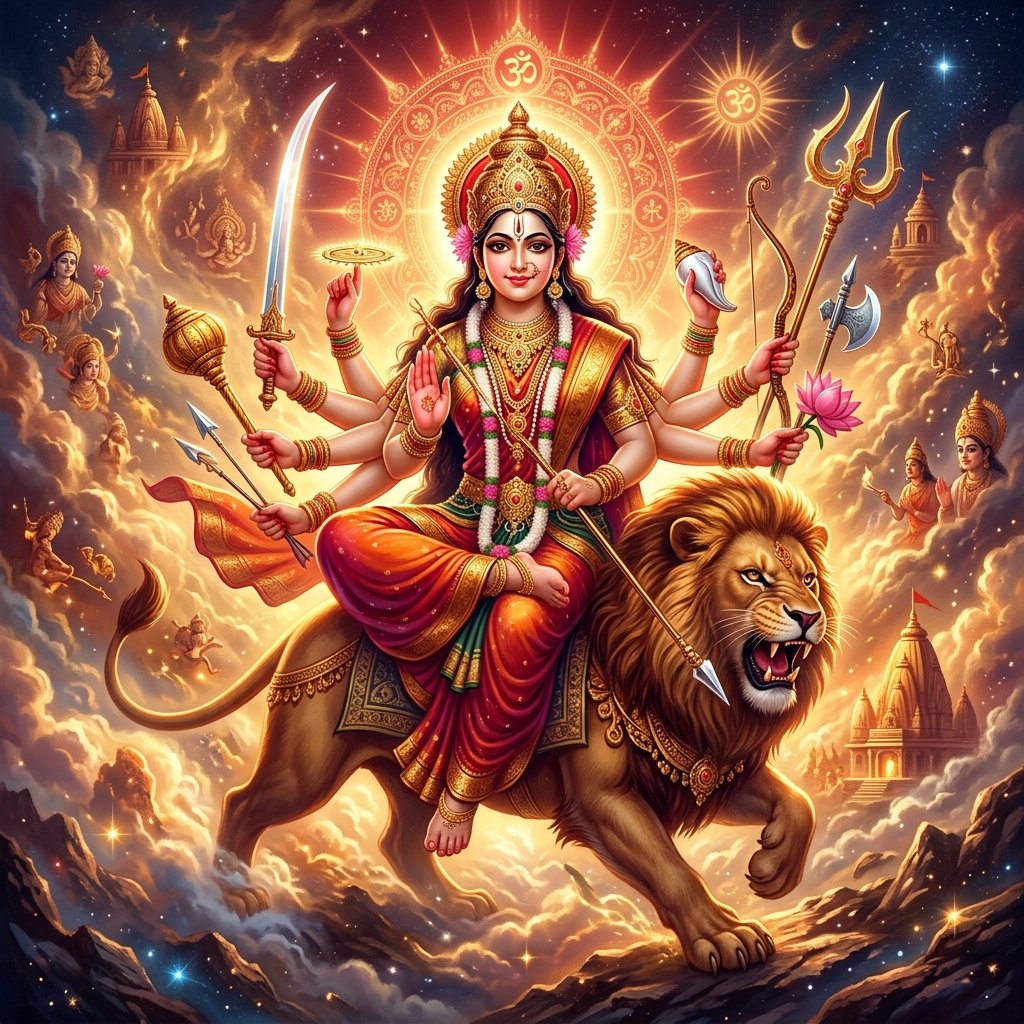
Maa Sherawali represents Goddess Durga, the ultimate source of cosmic energy (Adi Parashakti). She is depicted riding a lion, carrying symbolic weapons in her multiple arms. The name 'Sherawali' relates to her mount, the lion (Sher), which symbolizes her command over raw power, fear, and bestial instincts. Maa Durga represents the protective motherly force that destroys evil, restores cosmic balance, and shields her children from harm.
Worshiping Maa Durga provides mental resilience, inner courage, physical strength, and victory over internal bondages like greed, anger, and ego. She is worshiped with great devotion during Navratri and weekly on Fridays.
The legend of Maa Durga (Sherawali) is celebrated in the Devi Mahatmya. When the shape-shifting buffalo demon Mahishasura unleashed terror upon the heavens and earth, having secured a boon that no man or male god could defeat him, the gods were powerless. In response, Brahma, Vishnu, and Shiva merged their cosmic energies to create Goddess Durga. Each god gifted her their primary weapons: Shiva gave his trident, Vishnu his Sudarshana Chakra, Varuna his conch, Agni his spear, and Indra his thunderbolt.
Riding a ferocious lion, Maa Durga waged a fierce ten-day battle against Mahishasura, ultimately slaying him and restoring peace to the cosmos, earning her the name Mahishasuramardini. Spiritually, she represents the active power (Shakti) of the universe that destroys negative thoughts, fear, and ego within us, replacing them with spiritual strength, courage, and pure intelligence.
Fridays are especially sacred to Maa Durga, marked by congregational chanting, Lalita Sahasranama readings, and red flower offerings.
या देवी सर्वभूतेषु मातृरूपेण संस्थिता ।
नमस्तस्यै नमस्तस्यै नमस्तस्यै नमो नमः ॥
सर्वमङ्गलमाङ्गल्ये शिवे सर्वार्थसाधिके ।
शरण्ये त्र्यम्बके गौरि नारायणि नमोऽस्तु ते ॥
"To that Goddess who is present in all living beings as the Divine Mother, salutations to her, salutations to her, salutations to her, over and over again."
"Salutations to you, O Narayani, who is the auspiciousness of all auspiciousness, the consort of Shiva, who fulfills all desires, who is the ultimate refuge, who is three-eyed, and who is the golden mother Gauri."
"Sherawali" literally means "the one who rides a lion." The lion represents raw power, courage, and pride. By riding the lion, Maa Durga symbolizes her complete mastery over these raw forces, showing that she directs them for the protection of righteousness.
Offering a red embroidered Chunri (veil) represents devotion, respects the Goddess as the divine mother, and invokes her protective, auspicious blessings. It is a symbol of auspiciousness (Saubhagya) and maternal care.
Navratri is celebrated twice a year (Chaitra and Sharad) with nine nights of intense prayers. The temple coordinates daily Durga Saptashati paths, special Havan rituals, decorative alankars for the deity, Kanya Pooja (worship of young girls), and community prasad.